

Articulate Ghostwriting that Readers Devour
The ghostwriter’s job is to capture the essence of the storyteller behind the project and render it accurately and eloquently in written form. Good ghostwriters are well-read, well-lived souls themselves, with a ready ear for personality type, a solid grounding in various literary forms and a talent for knowing target audience likes and dislikes.
When a ghostwriter is hired
Ghostwriting projects start out in different ways. They might be a written text, a video, audio recording, a series of interviews or a collection of diaries, notes or cocktail napkin scribbles made along the road of life. For whatever reason, the project initiator cannot undertake the work him/herself and needs the help of an expert ghostwriter.
Why work with me?
I’m a writer who began his career in travel writing, switched to magazine reportage and editorial, then to copywriting in advertising, then web content, then video scripting and, more recently, TV & film screenwriting. As a copywriter, I inhabit a strange paradox in which I communicate on behalf of others things they know better than me. So ghostwriting, for me, came as a natural extension of copywriting. I bring a life experience that’s beyond unique, a Brobdingnagian vocabulary which I know when and when not to apply, a love of research and context, a need to read everything under the sun and a fierce addiction to daily writing.
"I inhabit a strange paradox in which I communicate on behalf of others things they know better than me."
- Paul Fenn, Toronto Copywriter
Articulate ghostwriting that readers devour
Whether it’s your autobiography, a novel or an academic book, you don’t want to assign its ghostwriting to just any schmuck. You need a veteran ghostwriter who understands the work’s subject matter, has an innate appreciation of your voice, and can deliver on your objectives for the piece. Ghostwriting requires time and trust, between writer and client. It’s worth your time to investigate prospective ghostwriters carefully.
What's in it for you
- A frank assessment of your project’s viability, scope of work, time required and estimated cost
- Detailed consultations regarding plot, message, story arcs, writing style, tonality and length of work
- For fiction, a well-written, engaging work containing fully realized story components, characters, key messages, metaphors, subtexts, etc., all tightly rendered
- For non-fiction, a work that inspires, imparts knowledge and meaning, provokes action, shares wisdom, riffs informally off lessons learned, all delivered in a succinct package
- A religious devotion to brevity and potency
- Grammatically correct text
- 3 rounds of revisions included in fee
- On-time delivery of each draft
My pledge
Mastery of varied tonalities is my forte. I span it all, from serious to angry to laconic to sarcastic to erudite to gripping to yarn-spinning to kid-friendly. I use metaphor in ways that make ideas click neatly into place in readers’ minds. My goal is to make everything I ghostwrite unputdownable and remembered by readers. You will never have to ask me to make it less boring. You’ll probably want to see recent writing samples. Just ask.
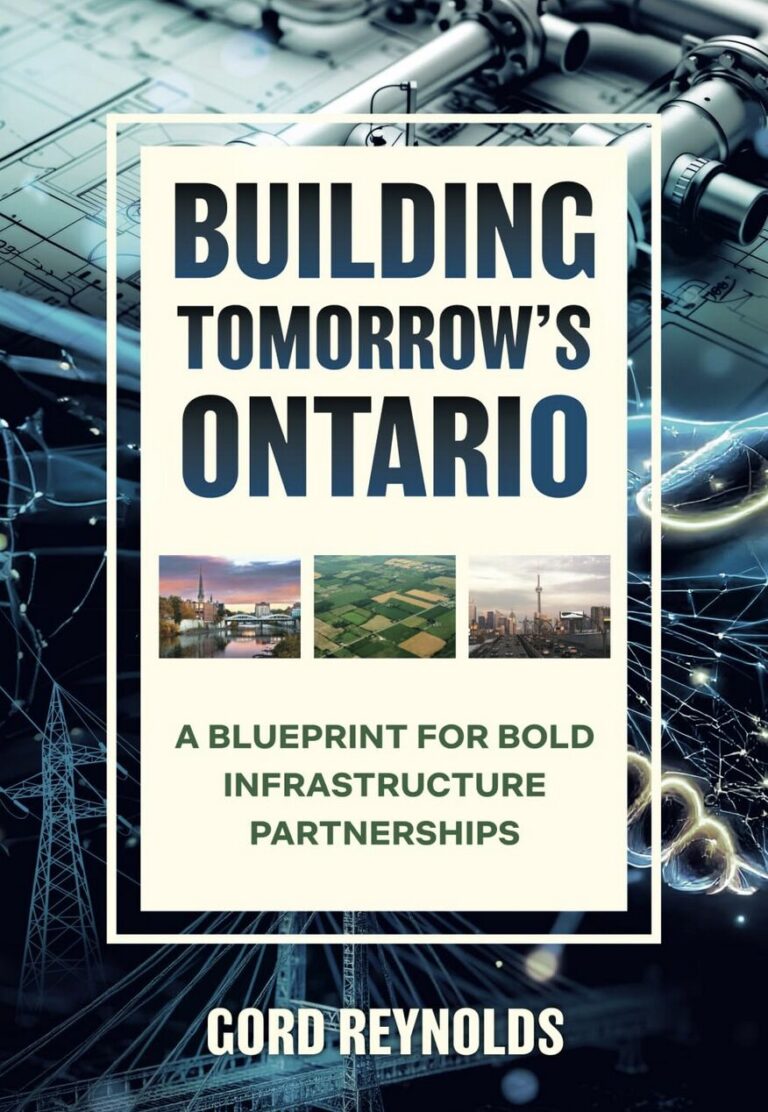
From Building Tomorrow’s Ontario: A Blueprint for Bold Infrastructure Partnerships, by Gord Reynolds. In Chapter 3, our veteran infrastructure builder shares a vignette on how he artfully tricked a room full of mutually suspicious interest groups into becoming a force united in its mission. (Read the story of humanizing a manuscript written almost entirely by ChatGPT.)
Having spent decades dealing with infrastructure projects, I’ll now reveal to you the most mind-blowing fact about them.
The construction is usually the easy part.
What keeps infrastructure professionals up nights isn’t the technical challenges – it’s getting everyone to agree on what we’re building, where we’re building it, how we’re going to find the people we need, if we’re going to get access to the supply chain we need and how we’re going to pay for it. And lately, I’ve been losing a lot of sleep. The dizzying scale of what Ontario needs to build over the next decade is daunting enough, but trying to coordinate it all while maintaining existing services? That’s the kind of challenge that makes veteran project managers consider early retirement.
Before talking solutions, I’d like to offer up a few insights into the state of the art in collaboration vs chaos that goes on in the process of getting infrastructure done in the fine province of Ontario. This will give you a taste of the stakes in play as we try to get the province’s infrastructural ducks in a row such that it might fully embrace its bright future.
Allow me to take you inside what we in this industry call the “collaboration dance.” Picture a stakeholders meeting held in downtown Toronto to discuss a major transit corridor expansion. We’re in one of those sleek boardrooms with floor-to-ceiling windows, the kind where you feel like you’re magically floating above the city. Around the table sit representatives from every possible infrastructure interest group – utilities, transit authorities, municipal planners, developers, environmental groups, community organizations. Each person clutches their coffee cups like a protective shield, ready to explain why their particular concern is the most important, why their timeline is the only possible one, why their budget constraints are absolutely non-negotiable.
The transit agency has spent months perfecting their route, only to discover it will require relocating hundreds of millions of dollars’ worth of underground utilities. The utility companies are adamant such a thing can’t possibly be done within the project timeline. The municipal officials are caught between supporting the transit expansion and protecting their infrastructure. The community representatives are concerned about construction disruptions. And there sits one lonely schmuck – that would be me – watching everyone talk past each other, wondering how we can ever find a path forward.
Having revisited this Groundhog Day scenario countless times, the schmuck has decided to try something different here. Instead of projecting yet another tiresome PowerPoint presentation, he has opted to bring in a roll of butcher paper with which he commences to cover the entire table, much to the confusion of everyone seated around it. He hands each interest group their own coloured marker, then asks them to draw their ideal version of the project.
What follows is amazing. The transit folks draw their perfect route in bold red lines. The utility representatives add in their infrastructure in blue, creating what looks like an epic needlepoint project come unravelled. The community groups add verdant green circles for parks and public spaces. The municipal planners try to make sense of it all with careful annotations here and there. By the end of the exercise, what has been created might be described as the world’s most expensive piece of collaborative art. But something important has happened:
People began talking to each other instead of at each other.
The transit planners and utility reps huddled in one corner, discussing utility relocations and leaving things in place and the protections required. The community groups and municipal officials were exploring ways to turn the construction disruptions into opportunities for neighborhood improvements and new public spaces. It wasn’t a solution yet, but it was the beginning of people working together instead of defending their territories to the death (of the project).
That session actually happened. And it taught me something priceless about stakeholder management: To make progress, sometimes you need to completely change the conversation. Why? Because it’s too damn easy to yell “No!” during a formal presentation, killing any momentum that might’ve somehow begun to carry the proceedings forward. But it’s much harder to maintain that rigid negativity stance when you’re literally drawing on the same page as everyone else and engaging in a constructive and collegial back and forth.
What You Get
Deep Research
Thorough research into your areas of interest (and if applicable) your company, its markets, audiences, competitive landscape, untapped opportunities – a detailed understanding of your world
Style & Tone
Before any writing commences, we discuss and agree on a specific writing style & tonality
Quality of Prose
A high quality of writing that speaks to your target audiences
Accuracy & Grammar
Persuasive, grammatically correct, active voice content. Proper content structure and formatting
Timely Delivery
Deadlines for each project milestone are set and met
Customer reviews
What My Clients Say
Related services: Biography · Editing & Proofreading · Speechwriter
Don't Be Shy
Contact
Get a quote, check on availability or just run an idea by me. I’ll get back to you within a day.
